


| Siteworks | ? | |
|
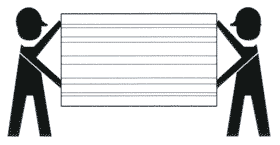
Transport Rooflights may be supplied loose, shrink wrapped, on pallets or crated to comply with customers requirements. Sheet lengths up to 8m can generally be supplied but lengths in excess of 12m will require special transportation and special consideration on manpower and/or crane off loading facilities. It is normal practice for sheet unloading to be the responsibility of the contractor/client, and specific off loading requirements must be notified to the manufacturer/supplier prior to despatch. Storage on Site Where possible store the rooflights indoors in cool dry conditions, avoiding direct sunlight. If outdoor storage is unavoidable, store in secure locations where the rooflights are unlikely to be stolen, damaged by site vehicles or foot traffic. Stack in plane rooflights on clean level battens at least 100mm wide. Curved barrel vault lights will require additional supports to prevent them spreading. Locate supports at 1.5m for GRP and 1.0m for thermoplastics, and limit stack heights for GRP to 1.5m and for thermoplastics to 1.0m. If the sun?s radiation, even on dull days, is allowed to pass unchecked through the layers of unprotected rooflight sheets, the pack of sheets could become a solar battery, where the infrared radiation is entrapped creating a continuous build up of heat. Any moisture entrapped between the sheets will then boil and the resulting vapour, now at high pressure, will discolour the sheets. Additionally, for the thermoplastic rooflights permanent sheet deformation could take place. To prevent this problem, always protect the sheet stack with reflective opaque waterproof covers draped over timbers to avoid direct contact with the rooflights and allow air circulation round the stack. Secure the covers to prevent wind damage and water penetration. Particularly in wet conditions, frequently check to ensure that water has not penetrated the stack. Note: These comments are particularly relevant when sheet stacks are loaded out on to a pitched roof. Without full cover protection, the upslope sheet ends are very vulnerable to driving rain entering the pack of sheets, with capillary and gravity taking the water to the centre of the stack. Handling Caution must be exercised when handling and installing rooflights in windy weather. Rooflights are frequently large, relatively lightweight, and when caught in gusting wind will endanger the personnel handling them and any person nearby. When handling single skin rooflights they should be supported at 3 metre centres. Long length single sheets may be carried by rolling the sheets across their width to form a cylinder and roped at 1.5 metre intervals. Ensure that the down turn on the exposed sheet edge faces downwards to prevent ropes from snagging on the sheet edges. When carrying multi skin factory assembled or barrel vault rooflights, care must be taken not to twist them. They should be carried at all time by two men, as illustrated, or more in the case of long units.
Cutting and Drilling Cut rooflights with a power saw having a 40/60 grit diamond blade operating at minimum speed. Alternatively, they can be cut with a hacksaw having 6 to 8 teeth per centimetre held at a shallow oblique angle. Holes must never be punched through rooflights as this can cause cracking around the holes. This reduces the pull through performance of the fasteners (i.e. the force required to pull the rooflight over the fastener when subject to suction loadings). Use standard metal drills for drilling GRP. Drill thermoplastics with masonry type drills, or metal drill bits having a point angle of 1300. To accommodate thermal movement in thermoplastic rooflights, the diameter of the holes where the primary fasteners are to be fixed, must be at least 10mm diameter. COSHH Regulations For GRP, polycarbonate and PVC when cutting or machining with power tools, a non-toxic biological inert dust is produced. These dust levels should be kept as low as reasonably practical, and must not exceed the Occupational Exposure Limit of 10mg/m3 ? 8 hour TWA value. When working outdoors, it is most unlikely that these levels could be reached. When working indoors or in confined areas, adequate ventilation should be provided. When extensive operations are necessary, suitable dust extraction equipment should be used. When cutting sheets, operators should always wear suitable dust masks and goggles to avoid any irritation in the nose, throat, lungs and eyes. In isolated cases, dust may cause slight transient irritation. Should these effects be prolonged or any sign of rash occur, medical advice must be obtained. All exposed skin must be thoroughly and frequently washed with soap and water. Any eye contamination must be washed with copious amounts of clean water. Sheet edges can be sharp, always wear gloves when handling sheets. Do not smoke in or near stores or working areas. Whilst the use of long length rooflights may reduce the number of end laps and reduce material costs, site conditions must be considered. A long length rooflight (exceeding 7 metres) is relatively light in weight, and when handled on high exposed buildings, can be awkward to handle even in mild blustery conditions. In the event of a fire involving rooflight material, the safe extinguishers to use are:
Noxious fumes may be produced which can contain carbon monoxide, carbon dioxide and soot particles. Breathing equipment is advisable in enclosed areas. ? |
? |
 Always wear protective leather gloves to avoid cuts from sharp edges of sheets.